
Don’t Let It Slip: The Rothen Group Repairs Aire and Calder Navigation Following Flood-Related Landslides
Site:
Aire and Calder Navigation
Date:
January 2025
Value:
The Aire and Calder Navigation has grown over the years and today transports significant amounts of raw materials across West Yorkshire. Following an embankment collapse, The Rothen Group were called on to carry out urgent repairworks and prevent a worsening situation.

The Project
Despite competition from road and rail, continual improvements over the years to the Aire and Calder Navigation means it remains a crucial logistics route, even after 300 years since it was constructed. The canal’s size is impressive, measuring 34 miles long and able to accommodate boats of up to 200ft in length that often weigh 700 tonnes or more. As such, the Aire and Calder Navigation has to remain traversable. So, when the canal was breached in December 2020, action needed to be taken.
Following an embankment collapse on the Don Drain section of the line, there were several areas where wash walls and piles failed because of dramatic changes in water levels. This resulted in a significant drop in hydrostatic pressure on the banks of the canal, causing piles and wash walls to fail and fall into the navigation. Two areas covering 300m were identified as requiring repair. The surrounding fields flooded in the aftermath while authorities rushed to stem the immediate risk to nearby properties and farmland. Because of the canal’s commercial importance and high flood threat, it could not be left to become more unstable.
The Canal & River Trust engaged JN Bentley to carry out urgent repair works and prevent a worsening situation. However, the extraordinary depth of the canal presented immediate challenges for the construction company. Most canals are approximately between one and one and a half metres deep, whereas the Aire and Calder Navigation has an average depth of over three metres to accommodate the size of the boats that use the waterway. This meant that long stability legs were needed for JN Bentley’s boats to be able to work in remote sections of the canal, and heavy-duty long piles would be required to adequately fix the embankment slip.
Due to the depth of the canal, The Rothen Group decided to back tie the cantilever piles to reduce the length required while keeping the strength and structural stability of the equipment. Normally, cantilever piles would not require a back tie, but since the teams working on the project could not access the site from the land, it would have been an impossible feat to get the right size kit on the water to be able to drive the cantilever piles in entirely.
The Rothen Group’s work on the Aire and Calder Navigation was also completed in keeping with JN Bentley’s ‘Beyond Zero’ health and safety scheme, which aims to go further than just minimising incidents while at work. The health and safety of all canal users including those working on site was prioritised throughout the embankment stabilisation project.


FEATURED CASE STUDY
Habitat Creation Coney Meadows, Droitwich
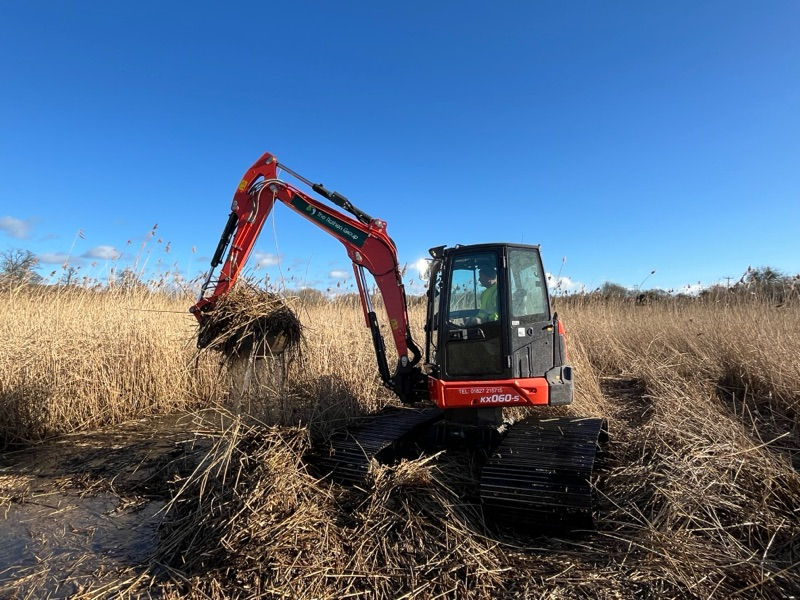
Coney Meadows is part of a nationwide project to restore the UK’s wetlands. Since the 17th century, large areas of reedbeds have been stripped and converted into agricultural land, massively reducing the number of habitats available for wetland animals.

FEATURED CASE STUDY
Changing the Shape of the River Derwent, Derby
Following the storm seasons of 2023 & 2024, the EA set out to review its impact on the UK’s waterways. The River Derwent in Derby was flagged after a sonar scan of its navigation identified a scour hole – a direct result of heavy rainfall pushing sediment downstream.


Our Accreditations
“I was extremely happy with the work ethic and the long hours The Rothen Group team put in to make sure the project stayed on track. The team were also very accommodating for our visitors and clients, always taking the time to go above and beyond while answering any questions they might have.
Most importantly, all the work was conducted safely. As on most projects, health and safety is our biggest risk and when we are working with plant on water and installing piles there’s a lot of risk involved. That’s why it’s so important that the whole team are on board with the ‘Beyond Zero’ campaign."
Matt Baldwin
JN Bentley