
Habitat Creation Coney Meadows, Droitwich
Site:
Coney Meadows, Droitwich
Date:
March 2025
Value:
Coney Meadows is part of a nationwide project to restore the UK’s wetlands. Since the 17th century, large areas of reedbeds have been stripped and converted into agricultural land, massively reducing the number of habitats available for wetland animals.

The Project
Since the restoration of Droitwich canal some time ago, the Coney Meadows that we know today became desolate. To combat this, large amounts of reeds were planted and this project entailed the creation of six ponds, ranging from 100m2 to 300m2 in size. A network of scrapes & channels were installed, along with the coppicing of trees to stimulate stronger, healthier growth over the next coming years. The material from this coppicing was later reused to create hibernacula and block an outfall, the latter increasing the water levels within the meadow.
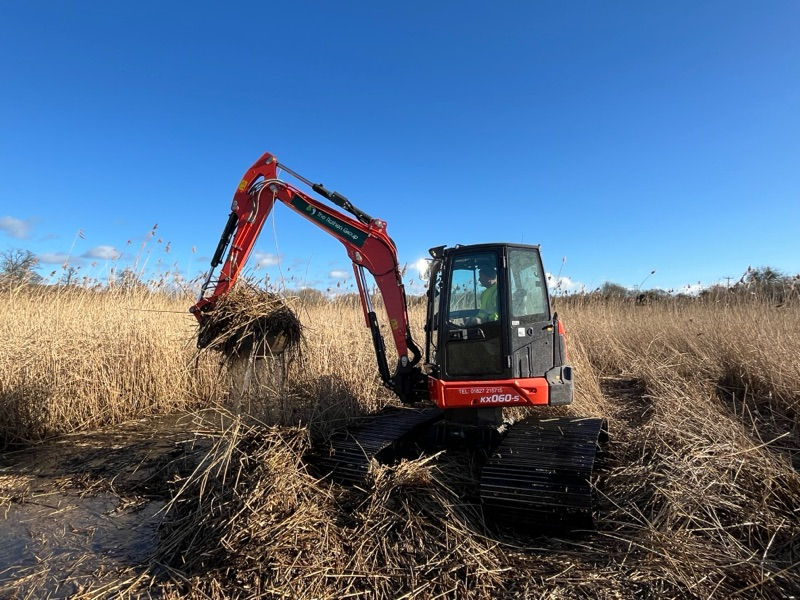
The Rothen Group's first task on this project was to dredge out 6 ponds, which we did using our 5t wide-tracked amphibious digger. Its raised cab allowed us to work in shallow water, making light work of this large dredging scheme. Over time, our team adjusted these ponds based on the water levels encountered, ensuring that the ponds naturally filled. Each pond had a minimum depth of 1m, with a combined total area of 1000m2.
Next, we set out to reinstate a network of scrapes and selectively coppiced trees on the way. The material gained from this was used to create hibernacula, which was an additional task we included in aid of providing insects and small animals habitat during the cold months.
According to Wildlife Trust, there are approximately 900 reedbeds in the UK, but only 50 of these are large enough to support the life of British native bird Bittern, just less than 6% in total. This is just one example of how our natural world is greatly reducing and becoming unable to support its own life. Along the coast, sea level rise due to climate change is also destroying reedbeds, leaving conservationists to focus on creating more of these habitats at inland sites in compensation. This is what the Coney Meadows project is a part of: rewilding our wetland areas to create more habitats and increase biodiversity on a local scale. At The Rothen Group, we place great importance on regenerative schemes such as this, which is why we accepted Wychavon Council’s requested for us to carry out their reedbed maintenance.


FEATURED CASE STUDY
Habitat Creation Coney Meadows, Droitwich
Coney Meadows is part of a nationwide project to restore the UK’s wetlands. Since the 17th century, large areas of reedbeds have been stripped and converted into agricultural land, massively reducing the number of habitats available for wetland animals.

FEATURED CASE STUDY
Changing the Shape of the River Derwent, Derby
Following the storm seasons of 2023 & 2024, the EA set out to review its impact on the UK’s waterways. The River Derwent in Derby was flagged after a sonar scan of its navigation identified a scour hole – a direct result of heavy rainfall pushing sediment downstream.


Our Accreditations