
Hemingford Lock Landing
Site:
Hemingford Lock Landing
Date:
January - May 2020
Value:
The Rothen Group were asked by JN Bentley and the Environment Agency to assist with upgrading a lock landing on River Great Ouse.

The Project
Understanding access & logistical restrictions
Time & ecological constraints including fish breeding season
Managing the changing river conditions in heavy winter flooding events
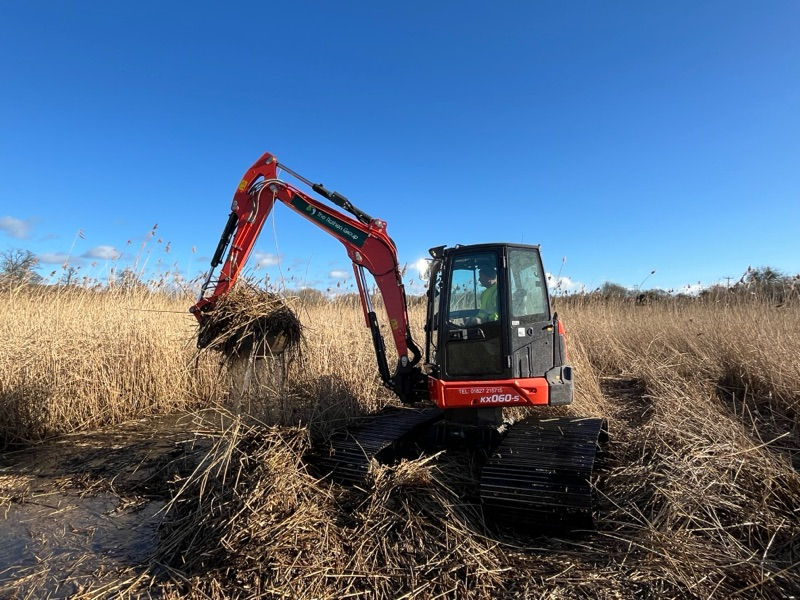
Vegetation clearance works
Installing 8.5m cantilever piles off floating plant
Fabricating new steel framing for GRP composite anti-slip decking
Installing an anti-slip walkway
Shuttering and concreting a new walkway behind the new piling line
Fabricating mooring bollards
Fitting a recycled plastic fender
Emergency works as a result of flooding - installing rock armour in scour holes
When Britain experienced higher-than-average rainfall, the planned works were delayed three times due to flooding. Specifically, the weir adjacent to the lock could not cope with the amount of water flowing over it, meaning the lock needed to be reversed into a temporary weir to allow greater flow downstream, and preventing works continuing due to dangerous conditions. This also presented a further concern – as the lock had to be reversed three times in a short period, a scour hole developed downstream, which could potentially undermine the adjacent lock and weir structure.
With peak season also approaching, the need to carry out remedial works and get the channel operating again so the lock could be replaced in time was even more crucial. As such, The Rothen Group quickly set to work dredging the silt bar, redistributing material into deeper parts of the waterway where it would not cause problems and blockages, with gravel placed atop the arisings in a teardrop shape to create new fish spawning grounds.
The Rothen Group utilised its specialist crane boat to remove the dredged materials, which features a clamshell with a 12-metre reach and four hydraulic jack legs to create a stable platform from which works can be carried out. In addition to this, the boat was fitted with internal, sealed tanks to allow more liquid material to be transported, reducing time spent carrying out dredging operations.
The challenge of quickly preparing the channel for upcoming work and with minimal disruption and preventing this issue again also required The Rothen Group’s specialist machinery and expertise. With this in mind, the company used large stone rip rap between 500-700mm in size to fill the scour hole. The specific friction properties of these stones meant they would not wash downstream if the river levels rose again, futureproofing the waterway.
Due to the rural location and aspiration to preserve the surroundings, the materials were loaded off site and floated to the lock via pusher tugs and hoppers. A total of 130 tonnes of stone were then placed by the crane boat in the desired areas, providing a fully functioning channel that enabled the installation of the new landing lock.


FEATURED CASE STUDY
Habitat Creation Coney Meadows, Droitwich
Coney Meadows is part of a nationwide project to restore the UK’s wetlands. Since the 17th century, large areas of reedbeds have been stripped and converted into agricultural land, massively reducing the number of habitats available for wetland animals.

FEATURED CASE STUDY
Changing the Shape of the River Derwent, Derby
Following the storm seasons of 2023 & 2024, the EA set out to review its impact on the UK’s waterways. The River Derwent in Derby was flagged after a sonar scan of its navigation identified a scour hole – a direct result of heavy rainfall pushing sediment downstream.


Our Accreditations
"One of the main challenges of the project was logistics and the location of the works. The site was very remote resulting in all materials needing to be floated to site. In addition, the kit had to be small enough to fit through a narrow lock to the north & a medieval bridge to the south, whilst having the ability to install the large piles required. The Rothen Group’s specialist machinery prevented having to bring in separate kit to carry out the additional emergency works, which decreased the amount of time the overall task took, allowing us to get traffic going through the channel again without a long delay."
JN Bentley