
The Rothen Group were asked by Canal & River Trust and Kier to assist with the emergency works at Marbury to stabilise the embankment. A 40m section of sheet piled washwall had failed leading to erosion of a narrow embankment between the canal & river. The bank had to be repaired by re-piling the washwall & installing rip-rap at the toe of the rear slope, without allowing further sections of the bank to collapse.

The Project
Emergency on site meetings to establish best plant/equipment and methodology for undertaking works
Quick mobilisation of team and plant to site where access was very awkward
Liaising with Canal & River Trust engineers and clients to approve works and design throughout project
Managing boat users as canal was closed during parts of the day
Undertaking piling works including all marine plant & experienced team
Laying rip rap and finishing works with topsoil & native wildflower mix
Following a period of heavy rainfall, a 40m section of piling had failed resulting in the canal navigation and towpath being closed. The site was remote and access tricky and with a brook running at the base of the bank and the canal at the top, potential further collapse was a risk. Having met on site on a Thursday, all the plant and materials were delivered to site on the Monday.
Our specialist 70ft crane boat was ideal for these works as it is not only powered but has a carrying capacity of 20t as well as a 15t/metre crane which can lift 1.6t at 8metres allowing for self loading/unloading of materials. This boat was also fitted with the piling hammers to install the piling. The initial drive was to stabilise the scoured bank sufficiently to allow the navigation to be reopened. This was achieved within a week, with 6G stone being loaded onto the boat from the site compound, floated to site and then unloaded directly into a geogrid to form a stable, stone platform. From this 1.8m trench sheets could be installed at the back of the bank and backtied. Additional stone could then be laid ontop, with rock rolls and riprap fitted.
The main 40m section of failed washwall had 3m piles installed behind the original piles (which acted as a dam until the new pile line was established). A galvanised whaler was fitted and the void was backfilled with puddling clay. A pile extractor was then used to extract the old piles for removal off site. The towpath was then reinstated allowing for the closure to be lifted.


FEATURED CASE STUDY
Habitat Creation Coney Meadows, Droitwich
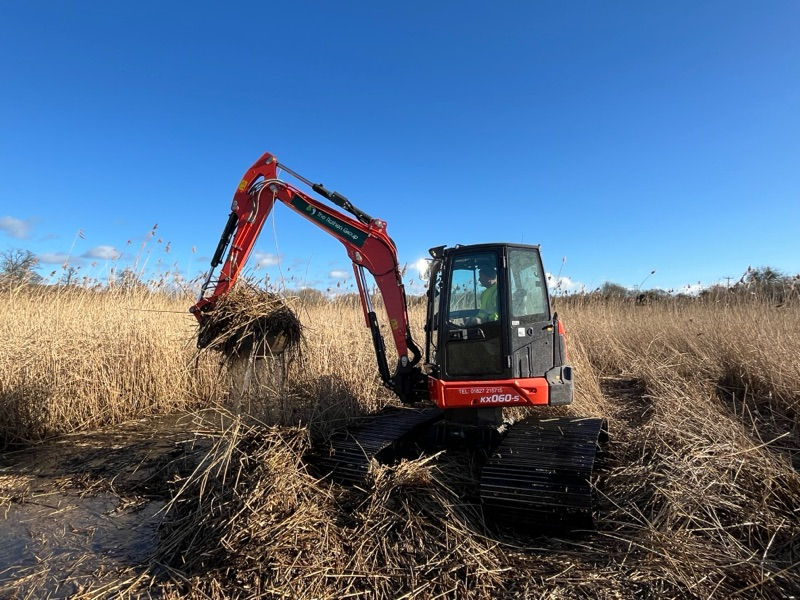
Coney Meadows is part of a nationwide project to restore the UK’s wetlands. Since the 17th century, large areas of reedbeds have been stripped and converted into agricultural land, massively reducing the number of habitats available for wetland animals.

FEATURED CASE STUDY
Changing the Shape of the River Derwent, Derby
Following the storm seasons of 2023 & 2024, the EA set out to review its impact on the UK’s waterways. The River Derwent in Derby was flagged after a sonar scan of its navigation identified a scour hole – a direct result of heavy rainfall pushing sediment downstream.


Our Accreditations