Polyurethane Grout vs Cementitious Grout: Which is Better?

Filling voids, sealing gaps, and stabilising structures, grout is used throughout any building project. We rely on it in many of our construction projects, from building retaining walls to repairing existing water infrastructure.

But there are two main types of grout:
Cementitious grout is the traditional option, made from cement, and commonly used for concrete slabs, brickwork, or structural voids.
Polyurethane grout is a newer formulation involving a chemical injection. It provides water-stopping and flexible sealing.
There is no “better option.” It depends on the site conditions, especially whether the priority is structural support, void filling, active leak sealing, movement tolerance, or speed.
In this article we'll discuss:
What Is Cementitious Grout?
Cementitious grout is a cement-based, flowable mixture used to fill voids, cracks, gaps, and spaces around structures. It’s the kind of grout most people are familiar with.
The Rothen Group relies on it for areas such as those beneath concrete slabs, towpaths, brickwork, and structural voids. It’s relatively cheap to formulate, using cement, water, sand, bentonite and other additives (depending on the job).
What Is Cementitious Grout Made From?
Cementitious grout is usually made from cement, water, and specialist additives. It is designed to flow into cracks, gaps, or voids before curing into a hard, durable material.
Some mixes also include bentonite, which can help the grout swell and create a tighter seal. Other additives, such as sand, plasticisers, accelerators, or waterproofing admixtures, may be used depending on the site conditions and required performance.
Common Uses for Cementitious Grouting
Cementitious grout is one of the most common materials used on building sites, as well as in canal repair and waterway infrastructure projects.
It’s used for:
Filling larger voids.
Supporting slabs or structures.
Filling cracks and leak paths.
Grouting beneath concrete slabs.
Towpaths, brickwork, waterway structures, and hard-to-access sites.
Baseplates, columns, anchoring, and construction applications where relevant.
What Is Polyurethane Grout?
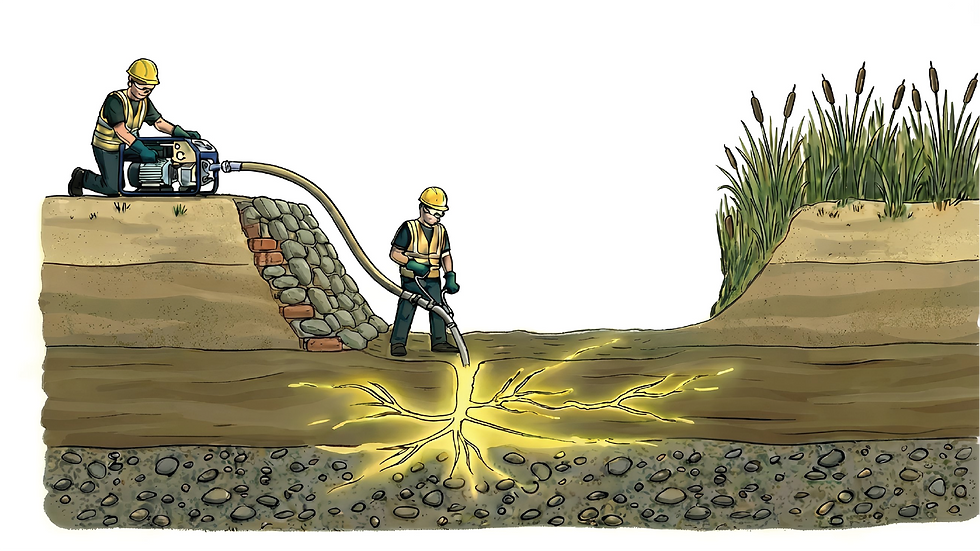
Polyurethane grout is a resin-based injection grout. It is injected into cracks, voids, joints, or leak paths. Depending on the formulation, it can expand to seal leaks or fill voids,
preventing water from getting through.
How Polyurethane Grout Injection Works
Depending on where the grout is needed, holes are drilled, or lances/nozzles are inserted. The grout is then injected under controlled pressure until the area is filled. Upon contact with water, the grout reacts, foams, and expands, creating a water-resistant seal.

Hydrophilic vs Hydrophobic Polyurethane Grout
Not all polyurethane grouts react with water in the same way.
Hydrophobic polyurethane grout: repels water, often foams and expands in contact with water, and is commonly used for leak sealing.
Hydrophilic polyurethane grout: absorbs/mixes with water, forms a flexible gel or seal, useful where ongoing moisture is present.
The product is chosen based on where the grout is being injected. Usually, the deciding factor is the amount of water. Hydrophobic grout is used if you need to stop active water movement, e.g., sealing a leak or filling a void, whereas hydrophilic grout is better for absorbing water, e.g., sealing damp or fine cracks.
Rapid Expansion and Water-Stopping Performance
One of the main benefits of polyurethane is the fast reaction times. As soon as it comes into contact with water, it rapidly expands, filling irregular gaps and water paths. It’s ideal for active leaks.
PU grout is the preferred choice for sealing cracks and joints, creating instant barriers to water flow, and re-levelling slabs and surfaces.
Polyurethane Grout vs Cementitious Grout: Key Differences
Factor | Cementitious Grout | Polyurethane Grout |
Main material | Cement-based mix | Resin or polymer-based grout |
Best for | Structural support, larger voids, and bulk filling | Leak sealing, water-stopping, and flexible sealing |
Water reaction | Can seal some leak paths depending on the mix | Often reacts with water, then foams and expands |
Flexibility | Rigid once cured | More flexible, depending on the formulation |
Best project fit | Dry or controllable voids, slabs, anchoring, and structural gaps | Active leaks, wet cracks, joints, movement, and water ingress |
How Does the Setting Time and Curing Speed Compare?
Cementitious grout takes more time to cure and gain strength (around 72 hours, depending on the mix). Once dried, it’s more stable, offering greater structural support. However, for quick and instant sealing, polyurethane grout is preferred due to its faster setting time.
I Need a Grout With Bond Strength and Structural Integrity
Cementitious grout is the better choice where structural support, rigidity, and compressive strength are necessary. That’s why it’s used for brickwork and towpaths.
By contrast, polyurethane grout can form a strong yet flexible waterproof bond rather than rigid structural support.
Which Grout is More Flexible and Resistant to Movement?
Polyurethane grout is naturally more flexible after curing. It can fill cracks, joints, and exposed structures exposed to vibration, minor settlement, and movement, where cementitious grout would crack and erode.
Which Grout is Better for Water-Stopping and Leak Sealing?
Polyurethane grout is once again the stronger option for active water leaks. It can rapidly expand and seal leak paths. However, cementitious grout is better for leak avoidance, preventing water from flowing into certain areas.
Is Polyurethane Grout Stronger Than Cement Grout?
“Stronger” depends on what you mean by strength. For compressive strength and rigid structural support, cementitious grout is far superior. But for waterproofing, crack sealing, and movement tolerance, polyurethane is a stronger practical solution.
Different materials for different problems.
Cost, Durability, and Environmental Considerations
Which Waterways Grout Is More Cost-Effective?
Cementitious grout usually has a lower initial material cost. It’s designed for large-scale void filling and large construction projects. Polyurethane is better for sealing smaller areas or providing quick leak resistance.
Which Grout Lasts Longer?
Both types of grout can last a long time in the right conditions. Longevity really depends on the product, substrate, water pressure, movement, and installation quality.
Environmental Considerations
Cementitious is closer to a natural material. It has a lower chemical impact and is generally better for sensitive sites. That said, cement itself has a large environmental impact in terms of carbon emissions.
Polyurethane grout is more chemically intensive. There are concerns about leaching into the local environment. However, it can be used with the correct application if the leakage risk is significant.
Polyurethane Grout or Cementitious Grout: Which Should You Choose?
Not sure which grout is right for your project? Follow a simple framework:
Choose cementitious grout when you need to fill larger voids, require rigid structural support, or where cost and bulk filling are major considerations.
Choose polyurethane grout when you need to stop active water ingress, require rapid expansion or fast setting, or are dealing with movement.
The Rothen Group offers support for all kinds of waterway projects, from towpath repair to ongoing maintenance. If you require support, get in touch with our team to find out how we can help.
Frequently Asked Questions
Can I Use Cementitious Grout to Stop an Active Water Leak?
Sometimes. It depends on the leak path, water pressure, and void size. For fast-moving leaks, polyurethane grout is normally the better option.
Which Grout Is Better for Soil Stabilisation?
Polyurethane grout is commonly used for rapid expansion, such as re-levelling slabs or void filling. However, if you’re dealing with a larger void or require load-bearing support, cementitious grout is the preferred option.
Does Polyurethane Grout Degrade Over Time?
Yes. All grouts will degrade over time. It can perform well if correctly specified and installed, especially in wet and moving environments.


Comments